Names have been changed throughout this article to protect the privacy and identities of the individuals concerned.
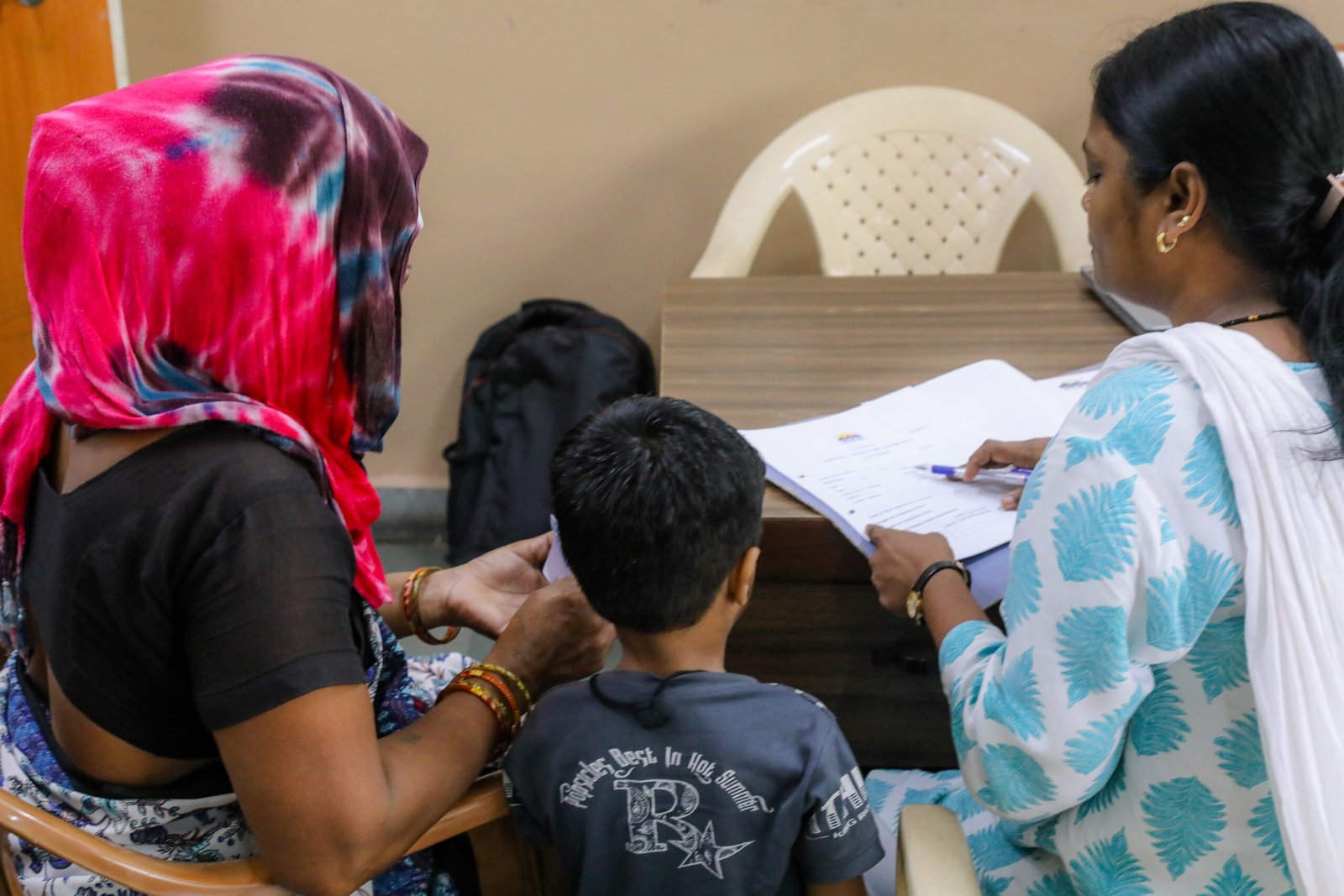
This issue is not new to us at Prerana. Over the last four decades of working with women and children in the localized sex trade, such as brothel-based red-light areas, Prerana has repeatedly encountered discrepancies in the names of mothers and their children across points of registration and official documents. These inconsistencies are not merely clerical or typographical errors; they are deeply connected to the lived realities of prostituted women — their trafficking, the social stigma they face, highly unstable relationships, migration, violence, and the absence of supportive documentation systems. While such differences in names may appear insignificant in everyday life, they often become major obstacles when these women and their children attempt to access entitlements, education, banking services, inheritance, or documentation establishing identity and eligibility.
One Ration Card, Two Surnames
In one of our recent case management meetings, Jyoti and Neelima, our social workers, shared a case involving a mother who wanted to add the names of both her children to her ration card. They guided the mother in collecting the required documents for both children, including their birth certificates, Aadhaar cards, and the bonafide certificates from school, which were needed to establish the children’s identities. Overcoming several challenges, the mother managed to obtain the necessary documents and submitted them to Prerana’s social worker for further processing.
While reviewing the papers, the social worker noticed that the surnames (last names) mentioned in the school bonafide certificates of the two siblings were completely different. The names of the two children were Kranti Shyama Pawar and Aarti Shyama Kamble. During the discussion that followed, the mother explained that the fathers of the two children were different and that both children had been born from different clients. Further scrutiny revealed that the mother’s own name also did not match consistently across the children’s documents.
The social workers sensitively explained to the mother that the ration office authorities were likely to raise questions regarding these discrepancies. They informed her that the mismatch in names across the documents could require additional supporting documents and might even necessitate affidavits, gazette notifications, or other legal processes to establish the relationship between the mother and the children in official records.
The matter remains pending.
When Paperwork Becomes A Barrier In Succession
This brought back memories of several similar cases from the past. Deepa, who had been trafficked into prostitution at the age of 17, had three children. Across various documents, their names appeared very differently. Deepa’s name was recorded as Deepa Kimchi Tamang. Her first child was named Kesang Kimchi Khan, the second Abdul Rahim Khan, and the third Renuka Deepa Patil. As an organization, it never mattered to us what names individuals chose to adopt. Names often reflect relationships, survival strategies, emotional attachments, social negotiations, or simply circumstances at a particular moment in time.
However, the difficulties emerged after Deepa died due to HIV-related co-infections. When efforts were made to help her children access the money in her bank account, the bank authorities asked for documentary proof establishing that Kesang, Abdul, and Renuka were all indeed Deepa’s children. At that time, banking systems did not have strict KYC procedures, and Deepa had not nominated anyone in her account. One of the major objections raised by the bank was that none of the children’s names matched the mother’s name in any obvious way.
The children could never access the money.
Names That Separate Siblings
The impact of such discrepancies is not always limited to legal or bureaucratic hurdles. Sometimes it also affects relationships and identity within families themselves. We have witnessed siblings with different names and identities struggling to have one another publicly acknowledged as family. In one such case, siblings named Ruksar Ahmed Ansari and Ruhi Renuka Patil found it difficult in their youth to acknowledge each other as siblings publicly, because their names reflected entirely different religious and social identities, which drew questions from society at large and from their peers at school.
Legal parentage in documentation is often impossible to establish, because biological fathers may be unknown, absent, deceased, unwilling to acknowledge paternity, or untraceable. This is, in fact, one of the biggest structural reasons documentation becomes complicated.
The Origin Of False Names At Birth
Reehan, another colleague, once worked with Rita from the Falkland Road red-light area. Rita delivered a child in a government hospital, where her pimp and brothel keeper (gharwali) were present with her during the delivery. The pimp falsely identified himself as the father and provided an incorrect name for Rita while completing the hospital documentation. As a result, the birth records did not correspond with Rita’s official identity documents, creating significant challenges. Rita later faced considerable difficulty when she wanted to open an account for her daughter under the Sukanya Samriddhi Yojana. These difficulties were eventually resolved by creating a notarized affidavit, publishing the change in local newspapers, and notifying the official Government Gazette.
In another case, a mother’s name on her bank account was completely different from the name on her PAN card. The name used during the admission of her first child in school differed from the name used for the second child, and the name appearing on her death certificate was entirely different. These inconsistencies created enormous difficulties for the children in obtaining an orphan certificate and accessing the support systems meant for them.
What We Do, And What Systems Must Do
Through years of engagement with women, adolescents, and young people in red-light areas, Prerana has recognized how deeply such documentation issues can affect the future of children and families. As a result, we encourage women to decide on one legally recognized identity and, wherever possible, to maintain consistency across subsequent identity and eligibility documents.
These conversations are always approached with sensitivity and without judgment. If women or young people seek support in bringing consistency to their records and identities, we assist them through the required legal and administrative processes.
During our discussions with the women, we have also learned that they may use different names for reasons of safety. In many cases, brothel keepers assign names; traffickers register women under false identities; hospitals record whatever information accompanies the woman; women may change their religion or surname depending on the influence or pressure of a regular customer or pimp; children have different fathers; and women sometimes intentionally conceal their identity from violent partners or families.
A name is far more than an administrative detail. For many women and children living in red-light areas, it determines whether they can prove who they are, access their rights, remain connected to their families, and build secure futures. Documentation systems must therefore recognize lived realities with the same seriousness that they recognize paperwork.
Documentation should become a bridge to inclusion, not a barrier that further marginalizes those already living on the socio-cultural peripheries.