The perspectives shared in this piece reflect the author’s personal views
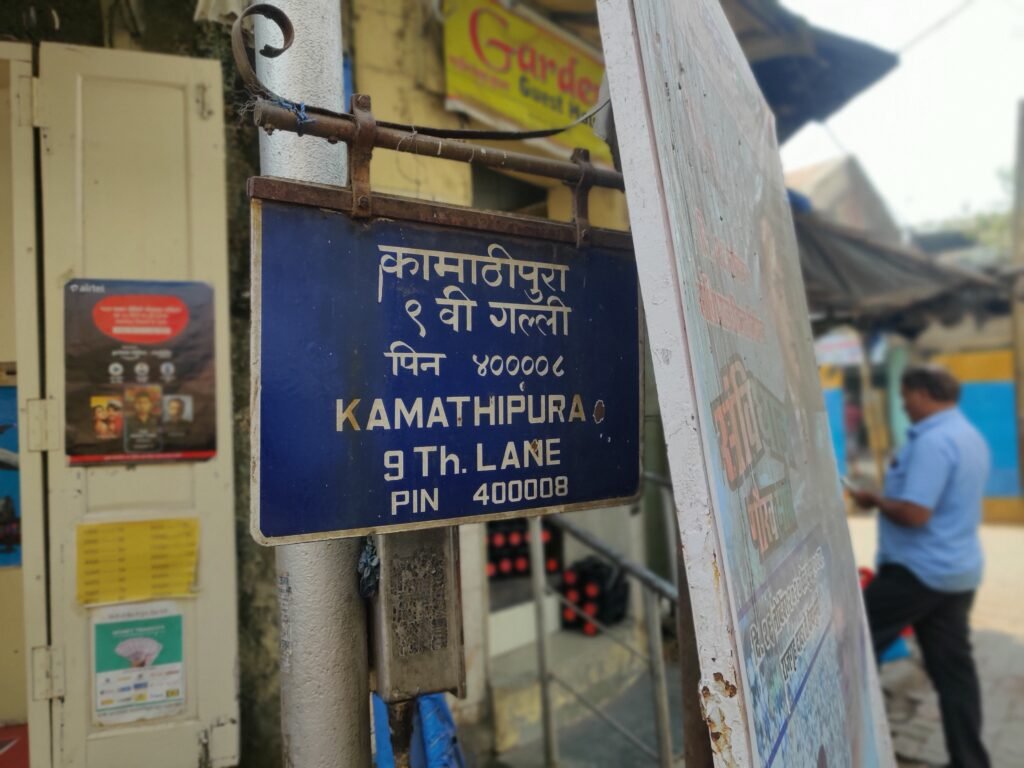 Kamathipura—one of the oldest and largest red-light areas (RLAs) in the Indian subcontinent—is undergoing rapid transformation. Over 800 crumbling buildings to make way for 57-Storey Rehab Towers once the State Cabinet approves.
In June 2025, the Maharashtra Housing & Area Development Authority (MHADA) invited tenders for Kamathipura’s ‘cluster redevelopment.’ This has generated questions, anxieties, debates, and widespread though unfounded expectations. The complex issue can only be understood by situating it within the historical and socio-economic context of Mumbai’s Red Light Areas.
Historical & Socio-economic Context of Migration and Housing
Mumbai (formerly Bombay) was the leading industrial city in colonial and postcolonial India, with textile mills and ports driving rapid urbanisation. Both institutions recruited labour through a distinctive pattern of male-select migration, drawing adult men from the rural hinterlands. In this process former farmers became urban wage labourers, while their households, now women-headed units, left behind in villages—became economically fragile.
To house the migrant workforce, the city developed uniform multi-storeyed cemented ‘chawls’ with small single rooms, common wash areas, and shared sanitation.
The Origin and Normalisation of Red Light Areas
Economic & ecological distress, caste-and gender based marginalisation, recurrent agrarian crises, and the breakdown of household viability facilitated forced or coerced migration of girls and young women to Mumbai. Many were trafficked into commercial sexual exploitation (sex trade) through deception, debt bondage, and cultural sanction. In some regions, ritualised systems such as the Devadasi and Jogini practices institutionalised the supply of girls to the sex trade.
Under the Contagious Diseases Acts and Cantonment Acts of the 1860s–70s, the British colonial authorities formally demarcated and regulated Red Light Areas (RLAs) in port cities (in Cantonments too) to meet the ever escalating demand of commercial sex created by the soldiers, sailors, and other male labour.
Over time, Kamathipura expanded as a site where the demand created by male-select migration intersected with the supply created by rural distress and trafficking. Under the tolerationist and regulatory policies of the colonial government the surveillance systems focused merely on preventing sexually transmitted infections among sailors and soldiers lest they should carry it back to England. Kamathipura soon became a physically deteriorated, overcrowded camp of sex slaves living a sub-human life.
Kamathipura: A System of Structured Violence
Kamathipura evolved into a densely populated enclave where trafficked and prostituted women—primarily from the lowest socio-economic strata—were kept under a variety of controlling systems. Commercial sexual exploitation operated through physical coercion, criminal confinement, debt cycles, and pressure of cultural malpractices.
Kamathipura also evolved a distinct identity namely the headquarter of organized crime. The area deteriorated into severely congested housing lacking basic infrastructure, while the social stigma became profound.
For many city elites the squalor of Kamathipura has been an eye sore and with the news of the recent ‘redevelopment’ they breathed a sigh of relief hoping that finally this will wipe out the ugly blot from the face of Bombay.
For yet another segment of people Kamathipura is synonymous with organized crime and they were happy that the redevelopment plan would wipe out the headquarters of crime and the stigma that came with it.
However, a small but critical segment of civil society recognised Kamathipura not merely as a site of urban decay and crime but as the destination of institutionalised misogyny. In their contention any positive intervention in Kamathipura must begin by denouncing human trafficking and commercial sexual exploitation (CSE) as the ultimate violation of human dignity and not to be tolerated in the name of ‘tradition’, ‘occupation’, or ‘inevitability of urbanization.’
On the Term ‘Redevelopment’
The term ‘development or redevelopment’ carries significant legitimizing power, often masking the large-scale displacement and destruction of vulnerable and marginalized populations. Historically, urban development schemes in India have harmed those without legal claims to land or housing documents and by depriving them of their resource base through land acquisition. The question is not merely one of infrastructure, it is about fairness and justice: who benefits from this “redevelopment,” and at whose cost?
The Rights-Based Intervention Lens
Late 1990s onwards, anti-trafficking civil society organizations in Mumbai intervened in the RLAs with clear rights-based interventions focusing on rescue, rehabilitation, justice, child protection, legal support, and dignity restoration. Their demands viz a viz modernization of places like Kamathipura are very clear:
- No eviction before rehabilitation,
- Compensation proportionate to harm and displacement,
- Dignified, long-term, and sustainable rehabilitation with social support; and
- Having a say in the decision making process and being heard
They contend that the inability of the women and children to produce documents of ownership, tenancy or occupation of the dwelling units in Kamathipura RLA cannot be used to deprive them of compensation, relocation, and rehabilitation. They argue that such absence of documents is not a neutral bureaucratic gap, it is integral to the history of victimisation. To use such absence as grounds for exclusion is to reproduce the injustice.
Current Transformations and “De-localisation”
The number of prostituted women in Kamathipura has declined from an estimated 75,000 in 1960 (Punekar, S. D., & Rao, K. (1962) A study of prostitutes in Bombay: With reference to family background) to around 10,000 in 2012 (Prerana ATC Census). However, this does not reflect a reduction in trafficking or sexual exploitation; rather, there has been a de-localisation of the sex trade, with operations shifting into dispersed and hidden sites across the city and region.
Many women were moved out of the Kamathipura RLA and resettled elsewhere by their traffickers and pimps. Many started living elsewhere far outside Kamathipura but kept coming down to the Kamathipura RLAs for using the beds in the brothels for transactional sex from where their pimps and the brothel keepers still continue to ensure the customers’ convenience. The women who were high in demand because of age, physical attributes, docility, and skin colour were picked up on priority by the traffickers and pimps under this relocation drive. Those considered less “in demand” may have been left behind. That doesn’t mean Kamathipura’s RLA is a decongested area today. The women who remain are perhaps weaker in comparison…but many of them still live and are getting exploited in Kamathipura’s brothels even today.
Those who are left in Kamathipura often live in precarious conditions. Their living conditions remain deplorable, dilapidated buildings, shared beds, no kitchen, no bathrooms, no private spaces, and inadequate sanitation.
Some women cook in shared corners of narrow corridors, use public toilets, and sleep on floors or shared beds. Yet, the area provides crucial informal support networks—including peer solidarity, access to CSOs, and relative predictability of survival. However minimal, these spaces have a system of provisioning and they still provide a fragile sense of safety and belonging in an otherwise unfeeling and hostile city. But ‘Redevelopment’ threatens to dismantle these fragile yet vital social support systems.
False Promises and Dangerous Hopes
As the ‘redevelopment’ slogan looms, misinformation too spreads easily. Local middlemen, pimps, brothel-keepers, and petty government officials—each seeing an opportunity for personal gain—circulate rumours of offering free flats and generous rehabilitation packages. Many older women believe they will receive apartments in the new buildings. This hope is built on desperation, fear, and illusion – not on facts. Under the false hope some keep giving their thumb impression on innumerable “affidavits” placed before them by the sex traders, moneylenders, and estate agents.
Without ownership papers, formal leases, or representation in any decision-making process, these women have no bargaining power. Once demolition begins, they will be left with nowhere to go or move to places wherever their pimps and agents will take them.
Since 2021, some prostituted women of the RLAs have transitioned to other forms of livelihood—domestic work, catering, small vending, working as peer educators, health workers — but housing insecurity keeps them bound to Kamathipura.
In a city that is structurally hostile to the poor, redevelopment without inclusion only aggravates marginalization. What is presented as progress often translates into further impoverishment through displacement.
The Imminent Risk
Demolition is likely to be sudden and forceful. The women and children currently residing in these brothels will not receive compensation or alternative housing, because they do not possess ownership documents. Meanwhile:
- Property owners, moneylenders, and absentee landlords stand to benefit.
- The women—who bore the violence and generated the profits—stand to lose everything.
As the Bulldozers Arrive
The women are living under a constant nightmare in Kamathipura’s RLAs. Soon on one of the dark nights the demolition squads of civic bodies, joined by the builders’ strongmen, additionally reinforced by the state police will suddenly swoop in on these buildings and forcefully evict them out with or without their belongings. The victim women and their children will have nowhere to go. They will be uprooted, scattered, and deprived of the community support and CSO assistance that sustains them today. Many will be pushed by the traffickers and brothel-keepers into new, hidden locations. Once again, they will vanish from the public sight.
These bulldozers, the vanguards of redevelopment will bring down the buildings but not wipe away institutionalised sexual slavery; only the victims will be hurled to distant invisible corners. The women, currently trapped in Kamathipura’s brothels, will not be freed; they will be made invisible and inapproachable. None of them will receive compensation or alternative housing, or any form of rehabilitation because none of them own the rooms they live/are exploited in, nor do they have any tenancy/occupancy documents. Many of these properties belong to the absentee landlords, traffickers, pimps, brothel-keepers, or moneylenders.
Despite living, suffering, and raising their children there, they have worked relentlessly to secure an education for their children, hoping to break the intergenerational cycle of marginalisation and victimisation. That dream now stands to be shattered. This administrative denial of their lives mirrors the moral neglect that mainstream society has long imposed upon them.
Conclusion: Development Without Justice
Urban transformation that excludes the most vulnerable reproduces structural violence. If redevelopment proceeds without recognition, participation, compensation, and rehabilitation for the trafficked and prostituted women of Kamathipura, it will merely erase their visibility. It will certainly not end their exploitation. On the contrary, it will aggravate their exploitation.
Redevelopment without justice is not progress. It is displacement, destruction, and further marginalisation.